

Core message: AI in revenue teams fails less from bad models than from collisions between well-functioning tools. Forrester‘s session identifies three collision zones and a fix for each.
Key data points
- 56% of genAI decision-makers see agentic sprawl as a significant or critical challenge.
- Only 34% of IT leaders say business functions sit on their AI governance committee, against 91% for data/AI functions.
- 66% of B2B marketers say genAI is overhyped.
Three collision zones and fixes
- Conflicting guidance: set clear decision rights and prioritization.
- Misaligned data and meaning: define shared definitions and canonical entities.
- Fragmented orchestration: codify orchestration rules, guardrails, and stop rules.
First steps: Inventory the tools and agents that advise on the same account. Document decision authority. Enforce shared identity and stop rules. Pilot one friction-heavy moment.
Use cases:
- The marketing seven cover content, SEO/AEO, segmentation, lifecycle journeys, scoring, experimentation, and attribution.
- The sales seven cover account research, next-best action, outbound sequencing, coaching, forecasting, proposals and quoting, and expansion signals.
- All seven in each list assume governed data and clear ownership.
Picture a runway where every plane has its own autopilot and no one is in the tower.
For CMOs, CROs, and RevOps leaders, the AI question has shifted from “which tool? to “who decides how the pieces fit together?”
Let’s explore together why AI tools collide, where the collisions happen, and how to fix them. Both in Marketing and in Sales.
The Problem: Every System Works and the Revenue Engine Still Stalls
Your marketing stack and sales stack are both large. Marketing runs a CMS with genAI, SEO/AEO tools, social, events, conversation automation, revenue marketing platforms, DAM, and market intelligence. Sales runs CRM, revenue operations platforms, AI coaching, CPQ, CLM, demo tools, and billing. Each vendor now ships its own AI or agents, and each one is “working as designed.”
The Forrester data shows the strain:
- 56% of genAI decision-makers call agentic sprawl a significant or critical challenge.
- Only 34% of IT decision-makers say business functions sit on their AI governance committee. For data and AI functions the figure is 91%.
- 50% of B2B marketing decision-makers know the technologies they use but not the entire marketing tech stack.
- Integrating new technology with existing systems is the number one challenge to delivering on IT priorities.
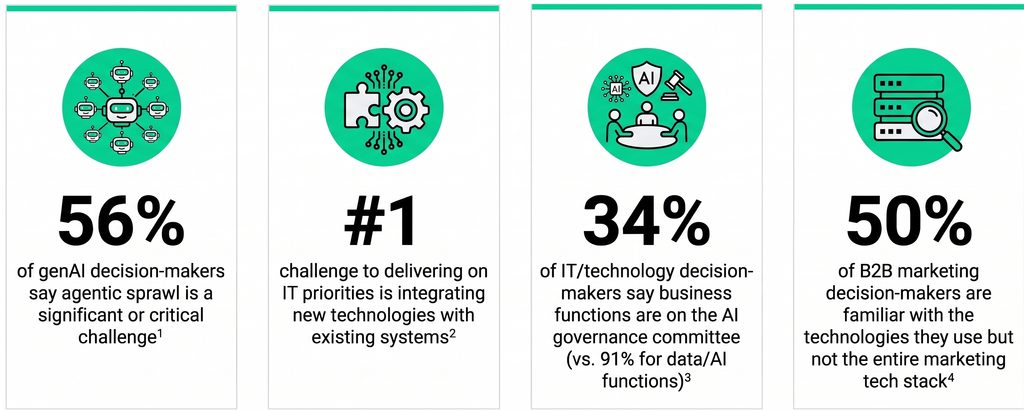
Source: Forrester 2026 research
Enthusiasm is also cooling. Two-thirds (66%) of B2B marketing decision-makers say genAI is overhyped. That includes 70% of AI laggards and 53% of AI leaders. Adoption is high, but the bottom-line proof is still catching up with the top-line promise.
For a CMO, CRO, or RevOps leader, this gap is where pipeline leaks. Your board wants AI-driven growth. Your teams are spending the time they saved reconciling what the tools tell them.
What Collisions Feel Like on the Ground
The people doing the work see the collisions first. Forrester captured their words: “The humans become the integration layer.” Another says, “We spend more time reconciling AI outputs than we ever saved.” A third describes the real problem: “The problem isn’t accuracy. It’s that we have five plausible recommendations.”
Three patterns follow:
- Cognitive overload erodes trust. Reps and marketers stop believing the guidance.
- Decision overlap creates chaos. Nobody agreed whose model takes precedence.
- Behavioral adaptation hides the cost. Teams ignore the advice and go manual, which wipes out the ROI case.
You won’t see this in a dashboard. You’ll see it as low adoption, inconsistent numbers, and a quiet return to spreadsheets.
The Three Collision Zones
1. Conflicting guidance
Several systems tell people to do different things for the same account. Marketing automation suggests launching a targeted ad. CRM guidance says engage the economic buyer. Customer success wants a QBR scheduled. These “next best action” directives compete, and humans have to settle the conflict.
The same happens with scores. Intent and fit scores, account prioritization, and engagement scores all claim authority. People don’t know which to trust. Pricing has its own version: a target price, rule-based discount tiers, and promo pricing can pull in different directions, so decisions stall or escalate.
2. Misaligned data and meaning
Systems disagree on basic definitions: contact identity, account hierarchy, firmographics, funnel and lifecycle stages, ICP, and readiness status. Agents then act on incompatible pictures of the customer. The result is premature, redundant, or inappropriate actions. Approved claims, consent management, and brand voice add compliance and brand risk.
As one practitioner put it, “We used to argue about data quality. Now we argue about meaning.”
3. Fragmented orchestration and control
Overlapping sequences, nudges, and duplicate emails mean customers get noise instead of orchestration. Sellers don’t know which system to listen to. Coaching and performance standards diverge. Forrester also warns about the opposite error: forcing alignment too early can choke useful ideation, such as marketing experimentation, early segmentation, and top-of-funnel engagement.
Three Fly-Right Plans
Forrester’s answer is a control-tower approach: coordinate AI across the revenue engine, don’t let each platform fly alone. Each collision zone has a matching plan.
| Collision zone | Fly-right plan | Operational shift | Agent-safe pattern |
| Conflicting guidance | Clear decision rights and prioritization | Name which system clears next-best action and which score serves which decision | Shared agents for recommendations and messaging, not one per platform |
| Misaligned data and meaning | Defined and aligned definitions | Standardize profiles, states, triggers, and compliance needs, then map systems to that spine | Feed agents canonical entities and lifecycle signals, not raw tool data |
| Fragmented orchestration | Codified orchestration and guidelines | Assign sequencing ownership; set cadence and suppression rules that can’t be bypassed | Agents act only in defined lanes, with stop rules, audit trails, and handoffs |
The signals of success are easy to recognize. Everyone knows what to trust, and decisions move forward without anyone asking “which system do we listen to?” Automation feels intentional and context-aware. Customers don’t feel swarmed, and teams stop switching automation off.
A Practical Starting Point
Forrester’s “what to do next” list is short enough to start working now with Signy AI:
- Inventory the tools and agents that recommend action for the same account or workflow.
- Document decision authority in each collision zone.
- Require agents to share the same identity, lifecycle signals, and stop rules.
- Start with one buyer or seller moment where AI causes hesitation, noise, or escalation.
Forrester also suggests a five-part health check for the stack, applied at the individual-tech, go-to-market, and enterprise levels: visibility, consistency, adoption, impact, and governance. If your teams can’t see the full journey, can’t agree on definitions, or can’t show KPI movement after deployment, adding more AI will make things worse.
7 Marketing Use Cases for AI
These work best once the foundations above are in place. The examples are illustrative patterns, not client results.
- AI-assisted content production and optimization. Teams use genAI to draft, localize, and refresh content, with approved claims and brand voice built into the workflow. This is where the “misaligned meaning” risk is highest, so governed inputs matter.
- SEO and AEO for AI search. Marketers audit content for visibility in both classic search and AI answer engines. They structure pages around entities and questions so LLMs can cite them.
- Account and audience segmentation. Models cluster accounts by fit, intent, and behavior. They run against one canonical ICP definition, so marketing and sales target the same accounts.
- Personalized lifecycle and nurture journeys. AI selects content and timing by lifecycle stage and consent status. Cadence and suppression rules prevent the duplicate emails Forrester flags.
- Predictive lead and intent scoring. One decisioning model, with its purpose stated, replaces the competing fit, intent, and engagement scores.
- Campaign and creative experimentation. AI generates variants and analyzes results quickly. Forrester’s caution applies: leave room for experimentation instead of locking it down too early.
- Attribution and performance insight. AI summarizes pipeline contribution and anomalies across channels. It draws on shared definitions, so marketing, sales, and finance see consistent numbers.
7 Sales Use Cases for AI
- Account prioritization and research briefs. AI assembles firmographics, trigger events, and buying-group context before outreach, so reps start from one account picture.
- Next-best-action guidance. One cleared system tells the rep what to do now, instead of five competing prompts. This is the “who gets to say do this now” principle.
- Personalized outbound and sequencing. AI drafts messages and manages sequences with shared stop rules and cross-channel suppression. This avoids swarming a buyer who is already in conversation.
- Conversation intelligence and AI coaching. Call analysis surfaces objections, talk ratios, and deal risks. Coaching standards stay consistent across managers and tools.
- Pipeline and forecast inspection. AI flags stalled deals, missing stakeholders, and slipping close dates. It reads CRM data with agreed stage definitions.
- Proposal, RFP, and quoting acceleration. Agents draft responses from approved content. CPQ and discount authority are explicit, so pricing doesn’t escalate by default.
- Customer expansion and renewal signals. AI watches usage, sentiment, and engagement to prompt QBRs and upsell conversations. It coordinates with the customer success owner so the customer hears one message.
How an Agency Partner Fits
Designing a control tower isn’t a tool purchase. It’s a cross-functional operating model that spans marketing, sales, RevOps, data, and AI. Most teams stall because no single function owns it. The work has four steps:
- Map the tools and agents that touch the same accounts.
- Settle definitions and decision rights.
- Pilot one high-friction moment.
- Measure KPI movement before scaling.
Our team works alongside yours on all four, then executes with you. The aim is AI that your people trust and use, not another layer to reconcile.